Free Contractor Matching Ramps, Stair Lifts, Doorways & Grab Bars Accessibility Work Across Ottawa
Find a Contractor

Part of the Ottawa Construction Network

Make Your Home Easier to Get Into and Around

Get matched with local Ottawa contractors for entrance ramps, stair lifts, wider doorways, grab bars and other accessibility work. See which funding programs list the work, what the Building Code asks of a house, and what published prices look like.

Free matching. No phone number needed. We do not inspect, license or screen the contractors we forward requests to, and we give no medical or device advice.

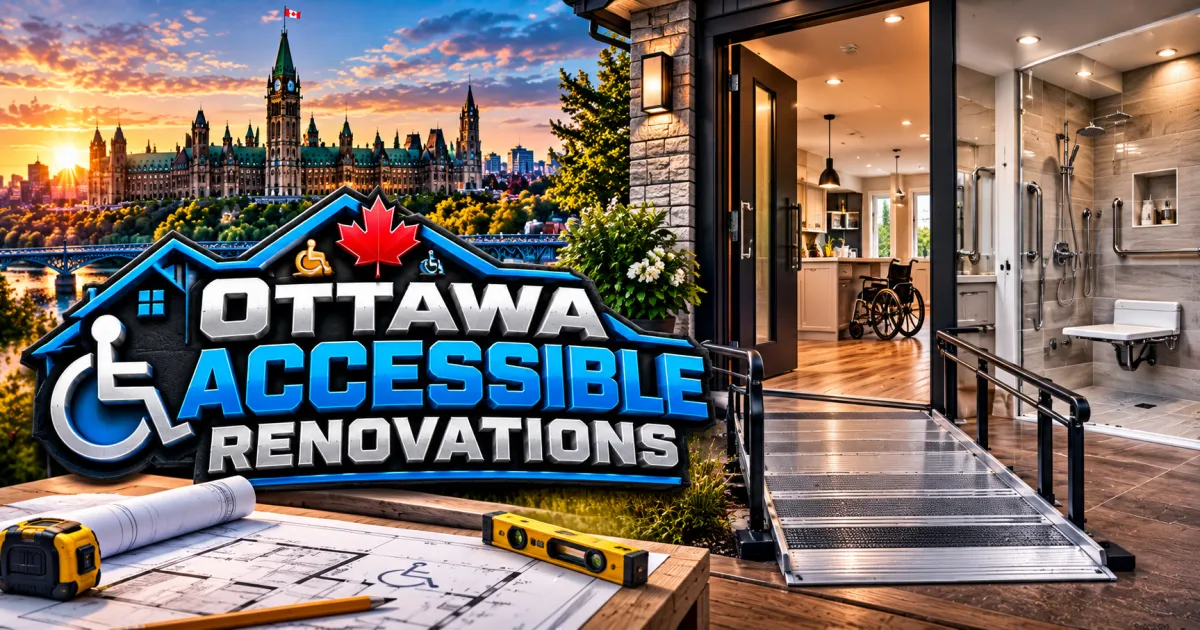
An Ottawa home's open front door reached by a metal ramp with handrails, a kitchen and an accessible shower with grab bars inside, Parliament Hill at sunset behind

Which Programs List This Work?

Answer three or four taps and see which open programs list this kind of work and what each one asks for. This is not an eligibility check: each program decides who is eligible. Program rules as published, checked September 2026.

Open programs that list this kind of work

Federal (CRA, line 31285)

Home Accessibility Tax Credit

Claim up to $20,000 of eligible expenses a year

For a person who is 65 or older at the end of the year, or eligible for the disability tax credit at any time in the year. The home must be owned and lived in by that person, or by a family member who claims and lives with them.

What it asks for
  • The renovation must be lasting and part of the home, and help the person get into, move around or function in it, or reduce the risk of harm.
  • Not reduced by grants or forgivable loans.
  • Keep invoices and receipts with the contractor's name, address and GST/HST number if applicable.

The program decides who is eligible. Source: CRA, line 31285 page (modified 2026-07-24); checked September 2026.

City of Ottawa homeowner program

Ontario Renovates (City of Ottawa)

Up to $20,000: a $15,000 10-year forgivable loan plus a $5,000 accessibility grant

For Ottawa homeowners who own and live in the home as their sole and principal residence, under the City's home-value and household-income limits, who are 65 or older, have a disability, or live with a senior or a person with a disability.

Income-tested: the program's own limits apply

What it asks for
  • Open until March 31, 2027, first come, first served.
  • Work done before approval is not eligible.
  • Eligible accessibility work may include ramps, handrails, chair and bath lifts, and height adjusted countertops.

The program decides who is eligible. Source: ottawa.ca, Ontario Renovates homeowner page; checked September 2026.

March of Dimes Canada, funded by Ontario

Home and Vehicle Modification Program

Up to $15,000 lifetime for home modifications

For permanent Ontario residents with a permanent, ongoing or recurring disability that impedes mobility, under the program's after-tax household income limits.

Income-tested: the program's own limits apply

What it asks for
  • No repayment for work done before the program authorizes it.
  • Solutions as recommended by an occupational therapist.
  • Renters need landlord approval; condo owners need a condo board letter.

The program decides who is eligible. Source: marchofdimes.ca, HVMP pages; checked September 2026.

Government of Ontario

Ontario Seniors Care at Home Tax Credit

25% of claimable medical expenses up to $6,000, for a maximum credit of $1,500

A credit on eligible medical expenses, under the program's own rules, for people who turned 70 or older in the year (or whose spouse or partner did). It is not a renovation grant. Reduced by 5% of family net income over $35,000.

Income-tested: the program's own limits apply

What it asks for
  • Its list of eligible medical expenses names bathroom aids such as grab bars, and some renovation costs where there is a severe and prolonged impairment. The program's rules decide what counts.

The program decides who is eligible. Source: ontario.ca (updated June 26, 2025); checked September 2026.

Government of Ontario

Ontario Seniors' Home Safety Tax Credit

Closed

It was available for the 2021 and 2022 tax years only, and it is not on the CRA's 2025 list of Ontario credits. Some contractor pages still advertise it.

Source: Ontario factsheet (October 18, 2023); CRA 2025 Ontario tax information.

The Multigenerational Home Renovation Tax Credit is for building a self-contained secondary unit, not for these jobs.
Get quotes for this work

Some programs will not pay for work done before they approve it. Check first, then compare written quotes.

Ramp Rules for a House Are Not the 1 in 12 You Have Heard

The 1 in 12 slope is the barrier-free standard for public buildings. For a ramp at your house, the Building Code's limit is 1 in 10.

Ramp length for a 450 mm rise: 1 in 10 versus 1 in 12 Side view to scale. A solid ramp at 1 in 10 needs 4.5 m to climb 450 mm to the door landing; a dashed reference line at 1 in 12, the public-building standard, needs 5.4 m. Door 1 in 10 · 4.5 m 1 in 12 · 5.4 m
Worked example: a 450 mm rise needs at least 4.5 m of ramp at 1 in 10, or 5.4 m at 1 in 12. Section 3.8, where the 1 in 12 slope comes from, does not apply to detached, semi-detached or row houses.
  • Solid: Your house (Part 9): 1 in 10, Building Code 9.8.5.4.(1)
  • Dashed: Public buildings (Section 3.8), reference only: 1 in 12, Building Code 3.8.3.4.(1)(b); not required in your house
Ramp length for a 450 mm rise
StandardSlopeRamp lengthSource
Your house (Part 9)1 in 104.5 mBuilding Code 9.8.5.4.(1)
Public buildings (Section 3.8), reference only1 in 125.4 mBuilding Code 3.8.3.4.(1)(b)

What the Building Code asks of a ramp at a house

1 in 10
Steepest slope for an exterior ramp at a house (Article 9.8.5.4)
860 mm
Narrowest width for a ramp serving one home (Article 9.8.5.2)
Top and bottom
Landings on any ramp steeper than 1 in 50 (Article 9.8.6.2)
400 mm
Rise at or below which a ramp serving one home needs no handrail (Article 9.8.7.1)
600 mm
Drop beside a ramp or landing above which a guard is needed (Article 9.8.8.1)

Ramps are not on the City of Ottawa's permit lists, and a deck at the main entrance needs a permit, so ask Building Code Services how your ramp and landing will be treated. Whether a gentler slope suits the person who will use it is for them and whoever advises them.

Get quotes for a ramp

Who Regulates a Stair Lift at Home?

Ontario Regulation 209/01 covers stair chair lifts and platform lifts, with two exemptions that matter at home.

  1. Is it in a private house used only by the people who live there and their guests?

    The Regulation does not apply, unless the owner asks in writing for it to apply.

    O. Reg. 209/01 s.2(3)(a)(i)
  2. Is the home rented, shared, or partly open to the public?

    TSSA publishes a questionnaire that decides whether it counts as a private dwelling house.

    TSSA, Am I Regulated?
  3. Does the lift rise 600 mm or less, and is it closed to the public?

    Lifts for persons with physical disabilities in that case are outside the Regulation.

    O. Reg. 209/01 s.2(3)(q)

TSSA adds that exempt devices may still be regulated by other bodies. Lifts are not on the City of Ottawa's permit lists; ask Building Code Services if the work changes floors, walls or stairs.

Get quotes for a stair lift

Can a Ramp Go in My Front Yard?

Ottawa's zoning by-laws treat a wheelchair ramp differently from ordinary front steps.

A ramp in the front yard, seen from above Schematic plan, not to scale. A house sits on its lot. A wheelchair ramp runs from the front door across the front yard to the front lot line, which zoning allows with no projection limit. Ordinary front steps must stay 0.6 m back from the lot line. Beyond the lot line is the City's road allowance, then the street. House Street 1 2 3
Schematic, not to scale.
  1. The ramp can reach the front lot line. Wheelchair ramps: no limit (Zoning By-law 2008-250, Table 65). Accessibility structures and devices: no setback or projection limit (Zoning By-law 2026-50, s.204).
  2. Ordinary steps stop short. Ordinary steps and landings, front yard: 0.6 m from the lot line (dashed line; both by-laws).
  3. Hatched: the City's road allowance. It is not part of your lot; the zoning rules above are about your own lot.

Both by-laws apply to permit applications complete on or after March 11, 2026, and the stricter rule governs. This is about your own lot: the road allowance in front of it belongs to the City. For a porch lift or anything other than a plain ramp, confirm with the City, since 2026-50 does not define the term.

Frequently Asked Questions

Is the Ontario Seniors' Home Safety Tax Credit still available?

No. Ontario's own factsheet says it was available for the 2021 and 2022 tax years only, and it is not on the CRA's list of Ontario credits for 2025 (checked September 2026). Some contractor pages still advertise it. The federal Home Accessibility Tax Credit is still open.

Do I need a permit to widen a doorway?

Yes. The City of Ottawa's permit list includes "enlarging or relocating a window or door". If the wall is load-bearing, the work is also a structural alteration. Ask for the permit to be named in the quote.

Someone came to my door selling a stair lift. Is that allowed?

Ontario's door-to-door ban covers furnaces, air conditioners, air cleaners and purifiers, water heaters, water treatment devices and duct cleaning. Stair lifts and renovation work are not on that list, but the Consumer Protection Act still applies: an agreement made in your home must be in writing, you can cancel it within 10 days of receiving your copy, and if you ask a salesperson to leave, they must leave right away.

Is Ottawa Accessible Renovations a contractor?

No. It is a free matching service. You describe the project, and the request goes to local Ottawa contractors who do accessibility work. We do not do the work, inspect it, or check contractors' credentials.

Get Matched Free

Tell us about the project and we send it to local Ottawa contractors who do accessibility work

Fields marked are required. No phone number needed — contractors can reply by email.

Find a Contractor